Old Wine in New Bottles: A Teacher’s Take on Modern Teaching Trends
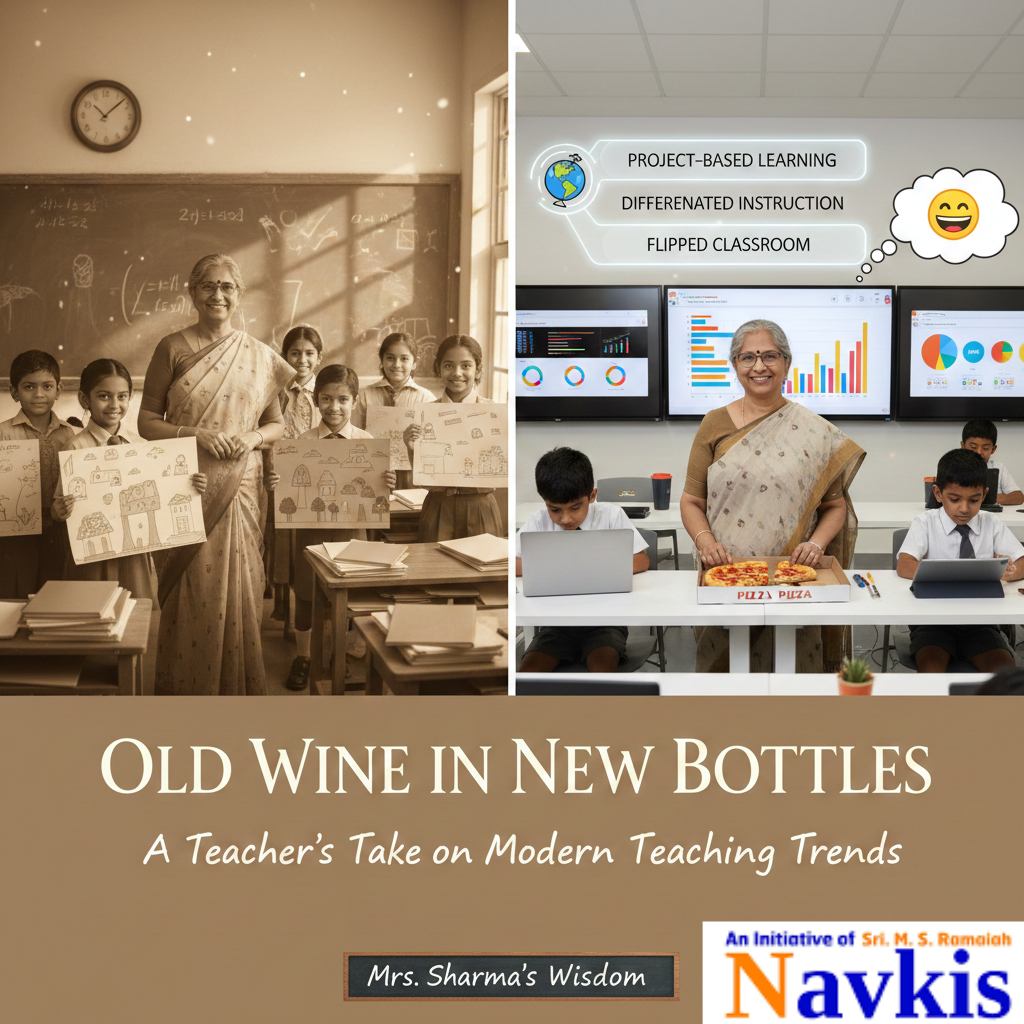
Meet Mrs. Sharma, a warm-hearted teacher in her 50s who’s spent over three decades shaping young minds in primary school. Back in the 90s, her classroom was a lively mix of chalk dust, piles of notebooks, and the occasional mischief from the back row. Fast forward to today, and she’s amazed at how new educational trends are essentially the same methods she used—just with fancier names.
Take “project-based learning,” for instance. Mrs. Sharma chuckles. “We used to call it ‘class activities,’ where the kids made posters and models. Now, they call it a ‘multi-disciplinary collaborative experience.’ Same concept, new lingo!” She fondly recalls guiding her students in creating maps of their neighbourhoods for social studies and building model houses to understand communities. “It was messy, chaotic, and fun. But the kids learned more than any slide show could ever teach.”
Then there’s “differentiated instruction,” or what Mrs. Sharma calls “customized teaching.” She remembers a time when she would give extra attention to students struggling with math while pushing the faster learners to do more challenging work. “I had a girl named Ria who found subtraction tricky, so I’d sit with her and go over it patiently. Meanwhile, Raj was breezing through multiplication, so I’d challenge him with word problems. Today, they’re calling it ‘individualized learning paths’ and creating software for it. Back then, it was just called being a good teacher.”
And the best one: “flipped classrooms.” Mrs. Sharma recalls, “In my day, we just called it ‘homework.’ Now they have apps for it!” She laughs and adds, “Perhaps I was ahead of my time. Maybe I should’ve patented the term ‘chalk and talk’. Kids used to go home with reading assignments, and then return to class ready to discuss. What’s the difference now except for the fancy apps and videos?”
She remembers an incident when one of her students, Ravi, struggled to understand the concept of fractions. “I didn’t use a digital whiteboard or fancy tools, but I had a pizza box, a pair of scissors, and a lot of enthusiasm. I cut the box into slices and showed him how to divide it. Ravi understood it immediately. No tech, just hands-on learning.” Mrs. Sharma is convinced that the essence of teaching hasn’t changed; only the tools have.
“Gamification?” she says, shaking her head. “When we played ‘Spelling Bee’ or ‘Math Bingo,’ that was the game, and it worked just fine! Now, they give it a new name and charge a subscription fee.”
Her eyes twinkle when she recalls, “One of my proudest moments was when I noticed Neelam—extremely quiet and shy—finally stand up in front of the class and deliver a poem she’d written herself. It wasn’t technology, just encouragement, and a lot of patience.”
Mrs. Sharma finds it amusing that modern education is simply “repackaging” the same age-old tried and tested techniques, only with more graphs and PowerPoints. “I was practicing innovation long before it was cool,” she says with a wink. “And the best part? My classroom always smelled like fresh chalk. There’s no app for that!”

Mrs. Neera Sharma
Mrs. Neera Sharma is the Head of Primary at Navkis Educational Centre corporate office. With 25 years of experience in the educational sector, Mrs. Sharma has held key positions at prestigious institutions, including Delhi Public School (Chandigarh and Bangalore), Cambridge School (Indira Puram, Ghaziabad), D.A.V. School (Delhi), and National Public School (Rajaji nagar, Bangalore). She is passionately devoted to education, and her extensive expertise empowers her to enrich students' learning experiences. Through her blog, "Old Concepts, New Approaches," she inspires others with insights into modern teaching trends