Balancing Bytes and Bonds: Online classes vs. Regular schooling
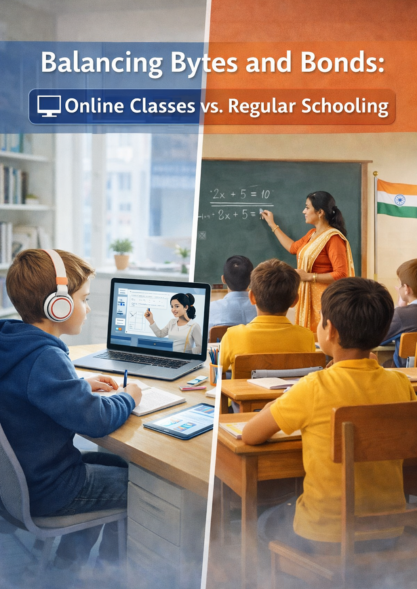
The accelerated growth of fully online K12 education raises a pressing question: can digital learning truly replace traditional schools, especially in a country as diverse as India? Both models offer distinct advantages and challenges, and as education evolves, a thoughtful blend may offer the most promise.
A student journey: The need for teacher presence
Kavitha, a Grade 8 student from Bengaluru, struggled to grasp Mathematics and Science concepts during the shift to online classes. Despite accessing digital lessons, she found herself isolated without real-time guidance. Her academic fortunes changed when her parents enrolled her in a hybrid program with weekend in-person sessions. The presence of teachers provided personalised support, immediate feedback, and peer discussions, significantly improving her confidence and results. Kavitha’s story illustrates that while online learning affords flexibility, active teacher involvement is crucial for effective and supportive learning.
Online learning: Freedom and Flexibility
Online schools have surged in popularity, particularly among families with unique needs—such as frequent travellers, expatriates, or young athletes. Platforms like K21 School allow personalised learning pathways and accommodate schedules that traditional schools often cannot. During the pandemic, many students appreciated the autonomy to learn at their own pace and the ability to explore personal interests. One high school student reported that the flexible environment let her pursue advanced courses in music composition while still excelling academically.
Hidden Costs: Social and Emotional Development
Online education, however, is not a cure-all. The social experience of traditional schooling nurtures resilience, empathy, and collaboration through real-world interactions—dimensions that remote platforms often lack. One student in a major urban centredescribed feeling increasingly isolated, missing extracurricular activities, group projects, and the daily company of classmates. For many, these are the elements that transform school from a place of instruction into a community.
Bridging the gap: Towards hybrid and inclusive models
Purely online programs present additional challenges: unequal access to technology, screen time that may impact mental and physical well-being, and hands-on, experiential learning—vital for the sciences and the arts—remain difficult to replicate virtually. Nevertheless, promising developments are emerging. Some schools offer hybrid models, combining digital courses with in-person meetups or labs. These programs have served students with special needs or chronic illness, providing both flexibility and vital social engagement.
Comprehensive teacher training, universal device access, and built-in counselling and peer interaction opportunities are proving essential to success. As Isaac Asimov famously imagined in ‘The Fun They Had,’ even the most advanced digital classrooms should not overlook the irreplaceable value of human connection.
Conclusion: The future is blended
There is no universal solution. Fully online schools offer access and flexibility, but cannot fully substitute for the social, emotional, and practical growth fostered in traditional environments. As India and the world shape the future of learning, integrating digital progress with the bonds of real community is the path forward. Schools must remain more than places of content delivery—they are spaces where tomorrow’s leaders develop the skills, empathy, and connections they need to thrive.
– Ms Leelavathi S
HOD Social Science
CTO, NEC, Kogilu

Ms Leelavathi S
Ms Leelavathi S is the Head of the Social Science Department at Navkis Educational Centre. She holds master’s degrees in Library and Information Science, Kannada Literature, and History, along with a Bachelor of Education (B.Ed.). A passionate educator, she strongly believes that schooling plays a crucial role in nurturing children into responsible, empathetic, and capable human beings. Her academic interests and professional experiences reflect her commitment to holistic education and meaningful learning. She is the author of the blog “Balancing Bytes and Bonds: The Future of Fully Online K–12 Schools in India,”where she highlights the irreplaceable value of regular schooling in supporting students’ social, emotional, and intellectual development, and in shaping them into confident learners and future-ready citizens.