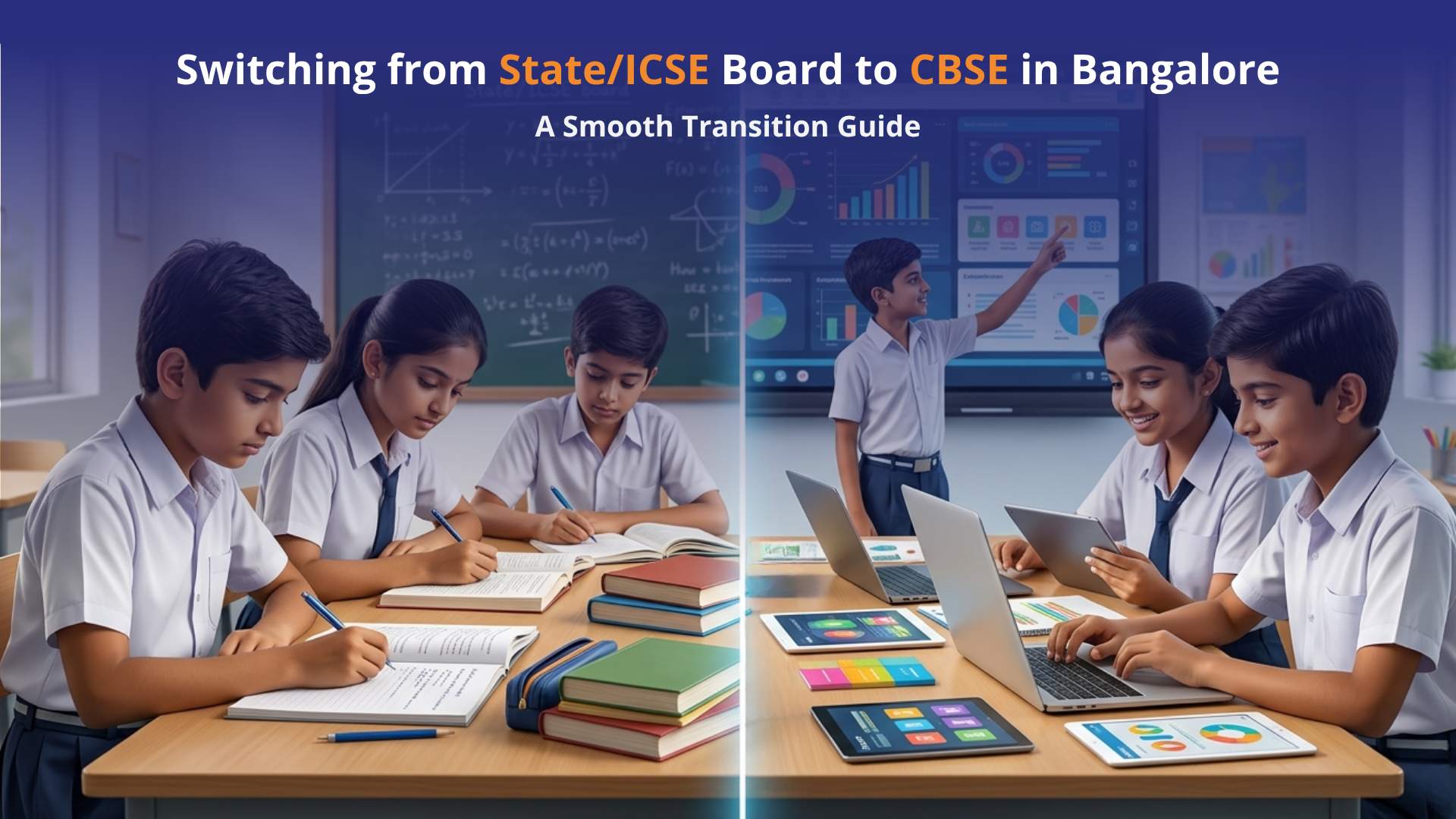
Switching from State/ICSE Board to CBSE in Bangalore: A Smooth Transition Guide
Switching from a State Board or ICSE syllabus to the CBSE curriculum is a common and often strategic move for many families in Bangalore. Parents consider this shift to align with a national-level curriculum, prepare for competitive exams like JEE and NEET, and benefit from the consistency of CBSE schools when relocating across cities.
To ensure a smooth and hassle-free transition, proper planning, documentation, and academic readiness are essential. This guide explains the key steps to help your child make the change successfully.
Why Make the Switch to CBSE?
Transitioning to the CBSE syllabus means moving to a nationally standardized curriculum that emphasizes conceptual clarity over rote learning, application-based learning and problem-solving skills, and a uniform assessment pattern. However, a smooth transition requires more than just filling out an admission form.
Step-by-Step Guide to Transitioning to CBSE
Step 1: Choose a CBSE-Affiliated School
Not all schools claiming to follow CBSE are officially affiliated. Before applying, verify the school’s affiliation status on the official CBSE website or by asking the school directly for their affiliation number. Once confirmed, check for seat availability in your child’s grade.
Step 2: Check Eligibility and Grade-Level Rules
CBSE and affiliated schools typically allow transfers only at specific entry points (Classes 1–9 and 11). Due to board regulations, a shift is usually not permitted in Class 10 or Class 12, as these are board examination years. Plan your transition accordingly.
Step 3: Prepare the Required Documents
Having your documents ready in advance can save weeks of delay. You will typically need: Transfer Certificate (TC) from the previous school, previous academic report cards (last 2-3 years), birth certificate (for verification of age), Aadhaar card or other government ID proof, and migration certificate (for students entering Class 11 or higher, if applicable).
Step 4: Understand the Academic Differences
The CBSE syllabus differs from State and ICSE boards, especially in Math, Science, and second languages. Take time to compare the syllabus of your child’s current grade with the CBSE curriculum for the same grade. You may find topics that your child hasn’t covered yet or some that are taught earlier in CBSE.
Step 5: Bridge the Syllabus Gaps
Once you identify the gaps, help your child cover them through NCERT textbooks (the foundation of CBSE learning), online learning resources, and guidance from teachers or tutors familiar with the CBSE pattern.
Step 6: Help Your Child Adjust to the CBSE Pace and Assessment Style
CBSE assessments are more concept-oriented and application-based. Your child may feel slightly pressured initially due to the faster pace or different questioning style. Encourage them to ask questions freely in class, seek help from peers and teachers, and practice with previous years’ CBSE question papers.
Is This Guide Reliable?
Yes. This guide is based on real-world observations of the CBSE admission process in Bangalore, an understanding of curriculum structure, eligibility rules, and transition strategies, alignment with official CBSE guidelines and commonly accepted school practices, and a focus on practical, parent-relevant information without promotional bias.
Switching from a State Board or ICSE to CBSE should be a well-planned decision. When done at the right time—avoiding board exam years—and with proper academic preparation, this transition can open up long-term advantages for your child’s academic and competitive exam journey.
If you are considering a CBSE transition for your child, we invite you to visit the Navkis School campus and speak with our academic team. We can help you understand eligibility, assess your child’s readiness, and provide the support needed for a confident and smooth academic journey.
FAQs
Q: What does CBSE stand for?
A: CBSE stands for the Central Board of Secondary Education.
Q: Is switching from ICSE to CBSE difficult?
A: No, it is not difficult if planned well. With proper academic guidance and timely support, students adapt smoothly from ICSE to CBSE.
Q: Are CBSE exams tougher than State Board exams?
A: Slightly yes, as they are more concept-oriented and require deeper understanding rather than memorization.
Q: Do students need external coaching after switching to CBSE?
A: Usually no. CBSE education is designed to thrive on school support, classroom teaching, and NCERT resources.
Q: Can a student switch boards multiple times?
A: While technically possible, it is not recommended. Frequent switches require repeated adjustments to different syllabi and assessment styles, which can disrupt academic continuity.
Admissions Open – Apply Now to Secure Your Child’s Seat at Navkis School